
Proactive network monitoring: what it is and why your company needs it.

Maintaining a stable corporate network is essential for productivity, security, and business continuity. However, many companies still adopt a reactive approach, only acting when the problem has already impacted users and systems.In this scenario, the proactive network monitoring It emerges as a fundamental strategy for companies that want to avoid failures, reduce risks, and ensure consistent performance of their IT infrastructure. Throughout this article, you will understand what proactive monitoring is, how it works, and, most importantly, why your company needs to adopt it. What is proactive network monitoring? The proactive network monitoringI t is a set of practices and tools that monitor, in real time, the performance, availability, and security of network assets, such as servers, switches, firewalls, internet links, and connected devices. Unlike the reactive model, in which the IT team only acts after a failure occurs, proactive monitoring allows…Identify anomalies before they become critical problems. Therefore, it is possible to act preventively, avoiding interruptions and impacts to the business. Furthermore, this type of monitoring provides continuous data that assists in decision-making and infrastructure planning. How does proactive monitoring work in practice? In general, proactive monitoring uses specialized software that collects network information 24 hours a day. These systems analyze important metrics and trigger automatic alerts whenever something deviates from the expected pattern. Among the main points monitored, the following stand out: In this way, the IT team can act quickly, ofteneven before the user notices any instability.. 📌 READ ALSO: IT Infrastructure: Common Mistakes Why is proactive monitoring essential for businesses? Currently, the network is the foundation of virtually all corporate operations. Therefore, any failure can lead to financial losses, decreased productivity, and even damage to the company’s reputation. Below are the main reasons to invest in proactive monitoring. Reducing downtime By identifying bottlenecks and failures at an early stage, proactive monitoring significantly reduces the risk of unexpected outages. As a result, critical systems remain available for longer. Increased productivity When the network is functioning correctly, employees can perform their tasks without interruption. Consequently, the time spent on emergency calls decreases, and the IT team can operate more strategically. Greater security for the IT environment. Continuous monitoring helps detect abnormal behavior, unauthorized access, and potential attack attempts. This gives the company an extra layer of protection for its data and systems. Planning and scalability With historical data and detailed reports, it becomes easier to plan upgrades, expansions, and infrastructure investments. In this way, IT ceases to be merely operational and begins to act in a preventive and strategic manner. Reactive monitoring vs. proactive monitoring: what’s the difference? Although both deal with network infrastructure, the difference between them is significant. No reactive monitoringHowever, action is only taken after the failure. This means that users are already being impacted, and the damage has often already occurred. On the other hand, theproactive monitoringIt anticipates problems, allowing for quick and planned corrections. In this way, the company avoids emergencies, reduces costs, and improves the quality of its IT services. Which companies should adopt proactive monitoring? In practice, all companies that rely on IT They benefit from proactive monitoring. However, it is even more suitable for organizations that: Regardless of size, adopting this model means more control and fewer surprises in daily life. How BHead can help your company. A Headoperates with complete solutions forIT infrastructure and managementWe offer proactive monitoring tailored to the needs of each business. Using the right tools and expert support, we help your company maintain a stable, secure network that’s ready for growth. Furthermore, our focus is prevent problems ensuring that IT functions as strategic support and not as an operational bottleneck. 📌 Want to know how to implement proactive monitoring in your company?💡 Get in touch withHead And speak with our team of IT experts.
Artificial Intelligence in Computer Networks

Artificial Intelligence (AI) is transforming various industries, and computer networks are no exception. Indeed, the automation and predictive analytics enabled by AI are revolutionizing network security, efficiency, and management. Therefore, in this article, we explore how AI is impacting computer networks and the main benefits of this technology. How Is Artificial Intelligence Transforming Computer Networks? AI can be applied to various areas of computer networks, optimizing processes and reducing human error. Furthermore, its continuous learning capacity makes these networks more intelligent and resilient. Below, we highlight some of the main applications: Automated Network Management AI enables continuous monitoring and automatic adjustments to network infrastructure. Consequently, machine learning algorithms analyze traffic in real time and perform dynamic optimizations to improve connection efficiency and speed. This keeps the network stable and agile. Advanced Cybersecurity Protecting against cyber threats is one of the main challenges facing computer networks. Fortunately, AI can detect unusual traffic patterns and identify threats before they cause damage. Furthermore, AI-based systems can automatically respond to attacks, minimizing risks and ensuring greater protection. 📌 Read also:Lenovo – What is Networked Artificial Intelligence Failure Prevention and Predictive Maintenance Machine learning can predict network infrastructure failures before they occur. This reduces downtime and improves the user experience. In this way, AI contributes to a more reliable and stable network environment. Traffic Optimization and Quality of Service (QoS) AI can automatically analyze and prioritize data packets. This ensures greater efficiency for critical services like video conferencing and live streaming. Furthermore, this automation improves the user experience and avoids unnecessary congestion. Autonomous and Self-Healing Networks With the advancement of AI, we’re moving toward autonomous networks that can adjust independently. In other words, these networks learn from the behavior of connected devices and make dynamic adjustments without the need for human intervention. This increases the reliability and resilience of IT infrastructure. 📌 Read also:Intelligent and Omnichannel IVR: The Evolution of Customer Service Benefits of Artificial Intelligence for Computer Networks The use of Artificial Intelligence in computer networks brings several advantages, such as: The Future of Networks with Artificial Intelligence With the rise of cloud computing, the Internet of Things (IoT), and 5G networks, Artificial Intelligence will become even more essential for network management. Therefore, companies that adopt AI-based solutions will be ahead of the competition, ensuring security, efficiency, and improved performance in their communication systems. Therefore, staying alert to innovations and investing in smart technologies will be essential to maintain competitiveness in the digital market. As a result, AI in computer networks is undoubtedly a path of no return toward a more efficient and secure future.
Structured Cabling: The Foundation for an Efficient Network
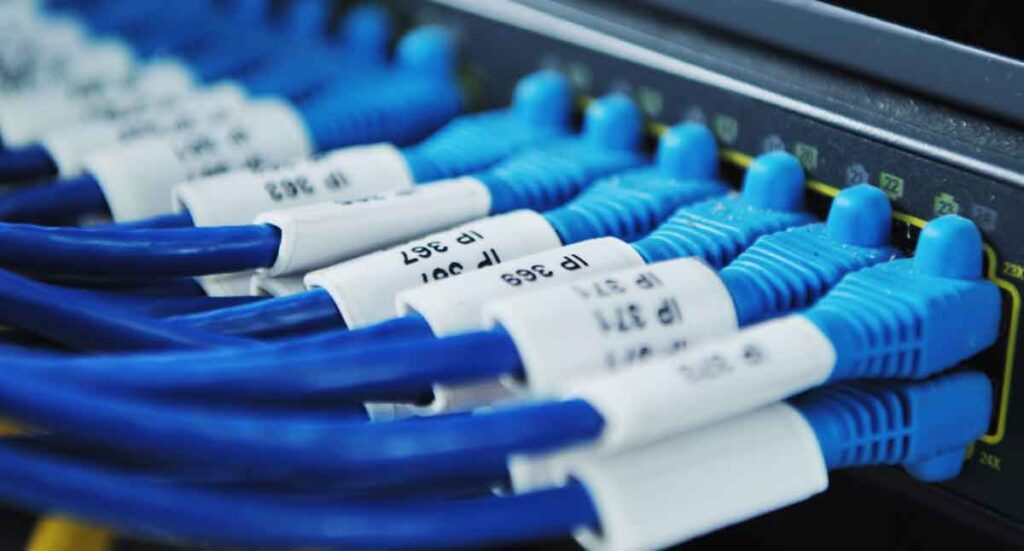
Nowadays, IT infrastructure is one of the fundamental pillars for any company that wants to grow efficiently. Furthermore, structured cabling plays an essential role in this scenario, ensuring fast, secure, and organized communication between devices and systems. Structured cabling is a standardized network infrastructure system that organizes and interconnects devices such as computers, servers, telephones, and other IT equipment. Unlike conventional installations, it follows specific standards (such as ANSI/TIA/EIA-568) to ensure performance, flexibility, and scalability. This way, your company can rely on a reliable infrastructure prepared for growth. This investment in the Network offers several advantages for companies of all sizes. Here are some of the main ones: Simplified Organization and Maintenance One of the biggest problems with conventional networks is cable clutter, which can make maintenance difficult and increase the risk of failure. Therefore, structured cabling standardizes organization, facilitating future repairs and expansions. Greater Speed and Stability Well-structured networks reduce interference and signal loss, ensuring faster and more stable connections. This allows companies that rely on the internet and internal systems to operate to operate more efficiently. Long-Term Cost Reduction Although the initial investment may seem high, structured cabling reduces maintenance costs, prevents unexpected downtime, and extends equipment lifespan. The result is significant savings in the long run. Structured Cabling: Scalability for the Future As technology advances, your company’s needs may change. Therefore, structured cabling allows for expansion without major complications, making it a future-proof solution. 📌 Read also:Field Service: On-Site Support Solutions with Excellence How to Implement Efficient Structured Cabling? The installation of a structured cabling system must be carried out by specialists to ensure quality and compliance with technical standards. The process includes: Contact BHead! If your company needs reliable and efficient infrastructure, BHead has the ideal solution. Furthermore, our specialized team guarantees a project tailored to your needs. Contact us now at WhatsAppand request a quote!