Every day, thousands of companies are targeted by online scams that begin in a seemingly harmless way: a simple email. In many cases, the message appears legitimate, uses the logo of a well-known company, and requests only a quick action. However, just one click is enough for confidential information to be compromised.
Therefore, knowing How to identify a phishing email It has become an indispensable skill for employees, managers, and IT professionals. In addition to preventing financial losses, this knowledge helps protect strategic data and ensures greater business continuity.
In this article, you will understand what phishing is, learn about the main warning signs, and discover how to significantly reduce the risks of this type of attack.
What is phishing?
Phishing is a technique used by criminals to deceive people and obtain confidential information. Typically, the attack occurs through fake emails that mimic communications from banks, suppliers, government agencies, well-known companies, or even colleagues.
The objective can vary. In some cases, criminals try to steal passwords and banking data. In others, they seek to install malicious programs on victims’ computers. Furthermore, many attacks aim to capture login credentials for corporate systems or cloud services.
Therefore, even a seemingly simple message can represent a significant risk for the company.
Why does phishing remain so effective?
Although security solutions have evolved considerably, criminals have also refined their strategies. Nowadays, many fraudulent emails have an extremely professional appearance.
Furthermore, they use genuine logos, convincing signatures, and well-written text. In some cases, the criminals even research public information on social media to personalize the message and increase the credibility of the scam.
As a result, identifying a fake email has become more difficult than it was a few years ago.
8 signs that help identify a phishing email
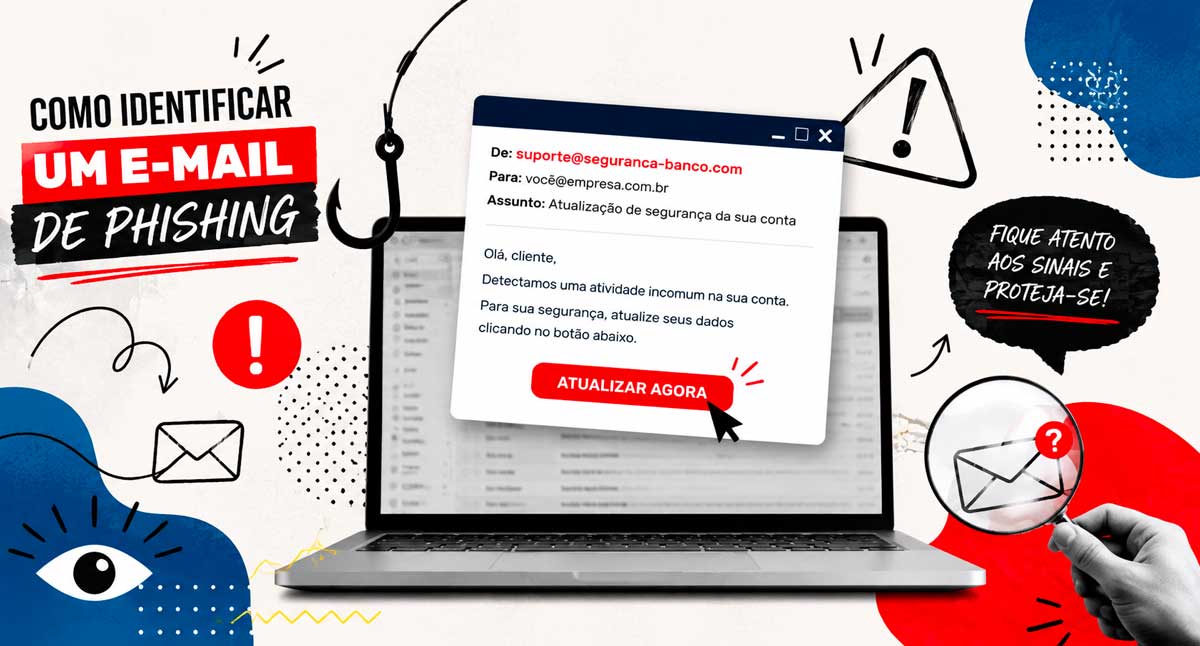
1. Carefully check the sender’s address.
The name displayed in the email may seem correct. However, the email address often reveals the fraud.
For example:
✔ financeiro@empresa.com.br
✖ financeiro@empresa-suporte.net
Therefore, always check the full address before trusting the message.
2. Be wary of messages that create a sense of urgency.
Criminals know that people under pressure make decisions faster. Therefore, they use phrases like:
- Your account will be blocked.
- Last chance.
- Please confirm your details immediately.
- Payment pending.
- Mandatory update.
Whenever there is pressure to act quickly, pause and verify the authenticity of the message.
3. Check for spelling and formatting errors.
Although many scams are well-crafted, it’s still common to find grammatical errors, automatic translations, words out of context, or strange formatting.
In addition, different fonts, misaligned images, and low-quality logos can also indicate an attempt at fraud.
4. Analyze the links before clicking.
Never click directly on links sent via email without verifying the destination address.
Before taking any action, hover your mouse over the link and check the displayed domain.
For example:
Text presented:
www.seubanco.com.br
True destiny:
seguranca-login-banco.xyz
This way, you can identify many scams even before accessing the page.
5. Never share confidential information via email.
Reputable companies rarely ask for this:
- Passwords;
- Authentication codes;
- Security tokens;
- Complete card details;
- Sensitive banking information.
If you receive such a request, stop the process immediately and confirm the information through official channels.
📌 READ ALSO: Why investing in digital security and antivirus software is essential for any company
6. Be careful with unexpected attachments.
Attached files may contain viruses or other malicious programs.
Formats that deserve more attention include:
- ZIP;
- RAR;
- EXE;
- DOCM;
- XLSM;
- JS.
However, even PDF files can be used in phishing campaigns. Therefore, only open attachments when you are certain of their origin.
7. Be wary of generic greetings.
Messages that begin with expressions such as:
- Dear customer;
- Dear user;
- Contributor;
- Madam);
They may indicate bulk shipments.
Although this doesn’t confirm fraud, it’s worth paying closer attention when other signs are also present.
8. Confirm changes to bank details.
A fairly common scam involves sending new bank details for payment to suppliers.
In this case, criminals often hack into a legitimate email account or create addresses that are very similar to the real ones.
Therefore, before changing any financial information, confirm the request by phone or through another official channel. This way, you significantly reduce the risk of losses.
What should you do if you receive a suspicious email?
If you receive a message that appears to be phishing, remain calm.
Right away:
- Don’t click on links;
- Do not open attachments;
- Do not reply to the sender;
- Do not provide personal information;
- Immediately notify the IT team;
- Delete the message only after receiving instructions from the responsible department.
Furthermore, if you have any doubts, contact the company that supposedly sent the email directly.
How to protect your company against phishing attacks.
Prevention depends on a combination of technology, processes, and employee awareness.
Among the main measures are:
- Regular training on digital security;
- Multifactor authentication (MFA);
- Advanced email protection solutions;
- Updated corporate antivirus software;
- Continuous monitoring of the infrastructure;
- Clear information security policies;
- Frequent backups;
- Simulated attacks for team training.
When these practices are adopted together, the company significantly reduces its exposure to threats.
What is the role of the IT team?
The IT team plays a key role in preventing attacks.
In addition to continuously monitoring the corporate environment, these professionals are responsible for configuring security filters, updating systems, blocking malicious domains, and guiding users on best practices.
Similarly, a specialized company can identify vulnerabilities before they are exploited by criminals.
Consequently, the organization gains more security, reduces operational risks, and improves its ability to respond to incidents.
Conclusion
Phishing attacks are becoming increasingly sophisticated. However, most of them can be prevented when employees receive adequate training and the company invests in a consistent information security strategy.
More than just installing protection tools, it’s essential to develop a culture of prevention. After all, a single click on a malicious email can compromise strategic information, disrupt operations, and cause financial losses.
Therefore, investing in technology, continuous monitoring, and team awareness is one of the smartest decisions any organization can make.
If your company wants to strengthen its digital security and reduce the risk of cyberattacks, rely on experts who combine experience, processes, and modern solutions to protect your IT environment.
- How to protect your company against ransomware.
- Corporate backup: why it’s indispensable for business continuity.
Talk to BHead
BHead offers complete solutions in IT support, information security, environment monitoring, infrastructure, and protection against digital threats.
Get in touch and discover how we can help your company operate with greater security, availability, and peace of mind.